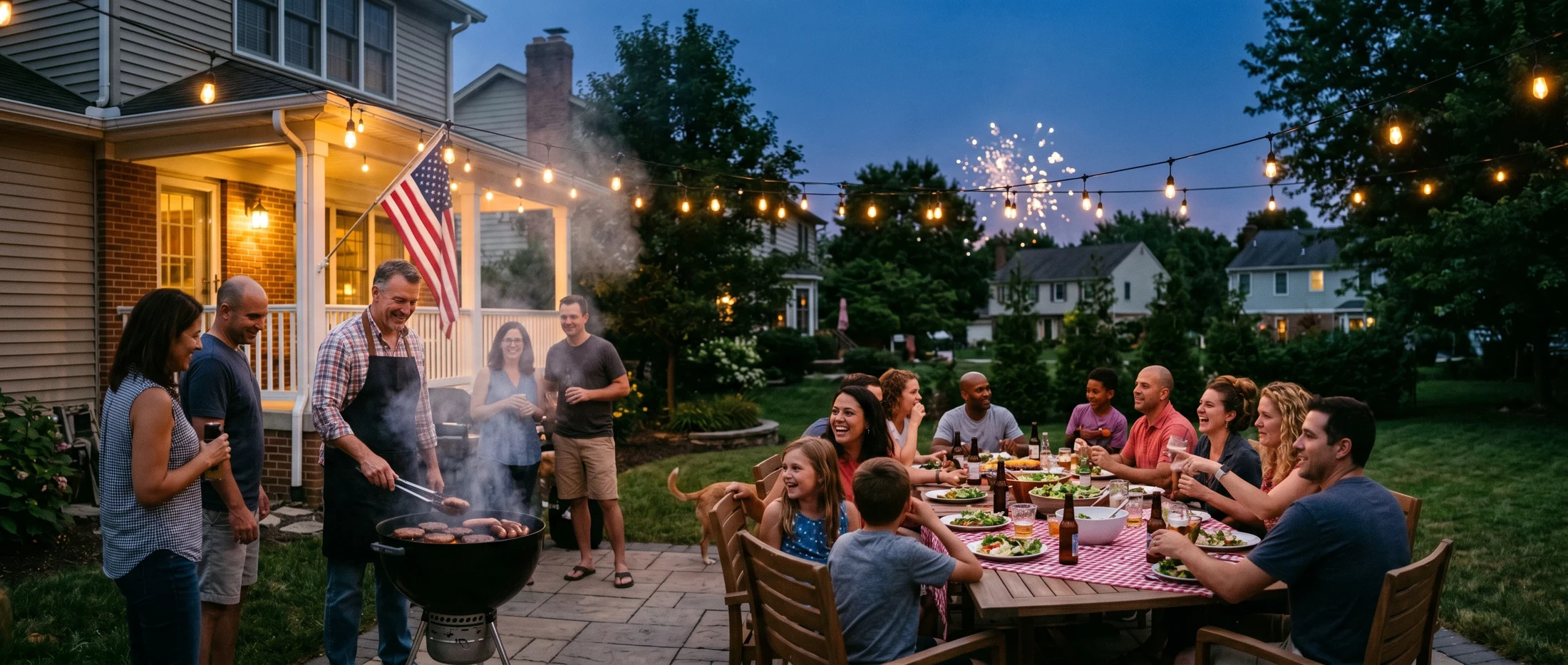
Across the Midwest, the Fourth of July means backyard cookouts, full driveways, sparklers in the yard, and at least one neighbor setting off fireworks that are a little bigger than the law strictly allows. It's the best weekend of the summer — and, quietly, one of the busiest for home-insurance claims. Grill fires, fireworks injuries, and guests who slip on a wet deck all spike around the holiday.
Here's a practical look at what your homeowners policy actually does (and doesn't) cover when you're hosting, and the coverage worth checking before the long weekend.
When You're the Host, You're the One on the Hook
The part most people don't think about: when you invite people onto your property, you take on a degree of responsibility for their safety. If a guest trips on a garden hose, burns a hand at the grill, or gets hurt by a firework in your yard, you can be held liable — and that's exactly what the personal liability portion of your homeowners policy is built for.
Standard homeowners policies in our footprint — Illinois, Indiana, Michigan, Minnesota, and Wisconsin — typically include two relevant coverages:
- Personal liability — pays for legal costs and damages if you're found responsible for a guest's injury. Most policies carry a limit of $100,000 to $500,000.
- Medical payments to others — a smaller no-fault amount (often $1,000 to $5,000) that covers a guest's minor medical bills regardless of who's at fault. This can quietly resolve a small injury before it ever becomes a claim or a lawsuit.
Fireworks: The Big Asterisk
This is where it pays to read the fine print. Coverage for fireworks-related injuries and damage often hinges on one thing: whether the fireworks were legal where you used them.
- Illinois. Consumer fireworks like firecrackers, bottle rockets, and Roman candles are illegal for the general public statewide — only sparklers and a few novelties are allowed. If a banned firework injures a guest or burns a neighbor's fence, your insurer may deny the liability claim on the grounds that you were engaged in an illegal act.
- Indiana. Consumer fireworks are broadly legal, which generally keeps you on firmer footing for coverage — but negligence still matters.
- Michigan, Minnesota & Wisconsin. Rules vary by type and by municipality, and Wisconsin in particular requires a permit for most aerial and explosive fireworks. Local ordinances can be stricter than state law.
Even where fireworks are legal, your policy still expects you to act reasonably. Handing a Roman candle to a 9-year-old, or lighting mortars under a tree, can be treated as negligence. The safest move — for your guests and your coverage — is to leave the big shows to the municipal display and keep your own celebration to what's legal in your town.
Grill Fires and Property Damage
Grills cause thousands of home fires every year, and the holiday weekend is the peak. The good news: if a grill fire damages your home, deck, or detached garage, your homeowners policy's dwelling and other structures coverage generally applies, subject to your deductible. If the fire spreads to a neighbor's property, your liability coverage is what responds.
A few things worth confirming now:
- Deck and patio structures. Built-in outdoor kitchens, pergolas, and large decks can be expensive to rebuild. Make sure your dwelling limit reflects them — this is a common gap we see when homeowners add outdoor living space but never update their coverage.
- Detached structures. Sheds and detached garages fall under “other structures,” usually capped at 10% of your dwelling limit. If you've got a nicer detached garage, check that the limit is enough.
- Your own injuries aren't covered here. Liability and med-pay cover guests, not you or your household members. Your own burns go through your health insurance.
Where Umbrella Coverage Earns Its Keep
Here's the scenario that keeps us recommending umbrella policies: a fireworks accident or a serious fall results in a hospital stay, lost wages, and a lawsuit. A $300,000 liability limit sounds like a lot — until a single severe injury blows past it. Once your homeowners liability is exhausted, the rest comes out of your savings, your home equity, and future income.
A personal umbrella policy sits on top of your home and auto liability and adds $1 million or more in protection — typically for just a few hundred dollars a year. For anyone who hosts gatherings, has a pool or trampoline, or simply has assets worth protecting, it's one of the best values in insurance. We walk through exactly how it works in our guide to understanding umbrella insurance.
A Quick Pre-Holiday Checklist
- Know your liability limit. Pull your declarations page and find your personal liability number. If it's $100,000, it's probably worth raising.
- Confirm your med-pay coverage. That small no-fault amount can resolve a minor guest injury without a formal claim.
- Check local fireworks law for your municipality — not just your state.
- Mind the obvious hazards. Keep the grill away from the house and railings, have a fire extinguisher within reach, and keep a bucket of water nearby for spent sparklers and fireworks.
- Consider an umbrella policy if you don't already have one — especially if you host often or have a pool, trampoline, or teen drivers in the house.
Have It Reviewed Before the Long Weekend
The best time to find out your liability limit is too low is not the day after a guest gets hurt. Send us your current homeowners declarations page and we'll do a quick, no-obligation review: we'll tell you what your liability and medical-payments limits actually are, whether your deck and other structures are properly covered, and whether an umbrella policy makes sense for your household.
Reach out here or call or text us at (312) 651-6759. Have a safe and happy Fourth of July from all of us at Six Corners Insurance.