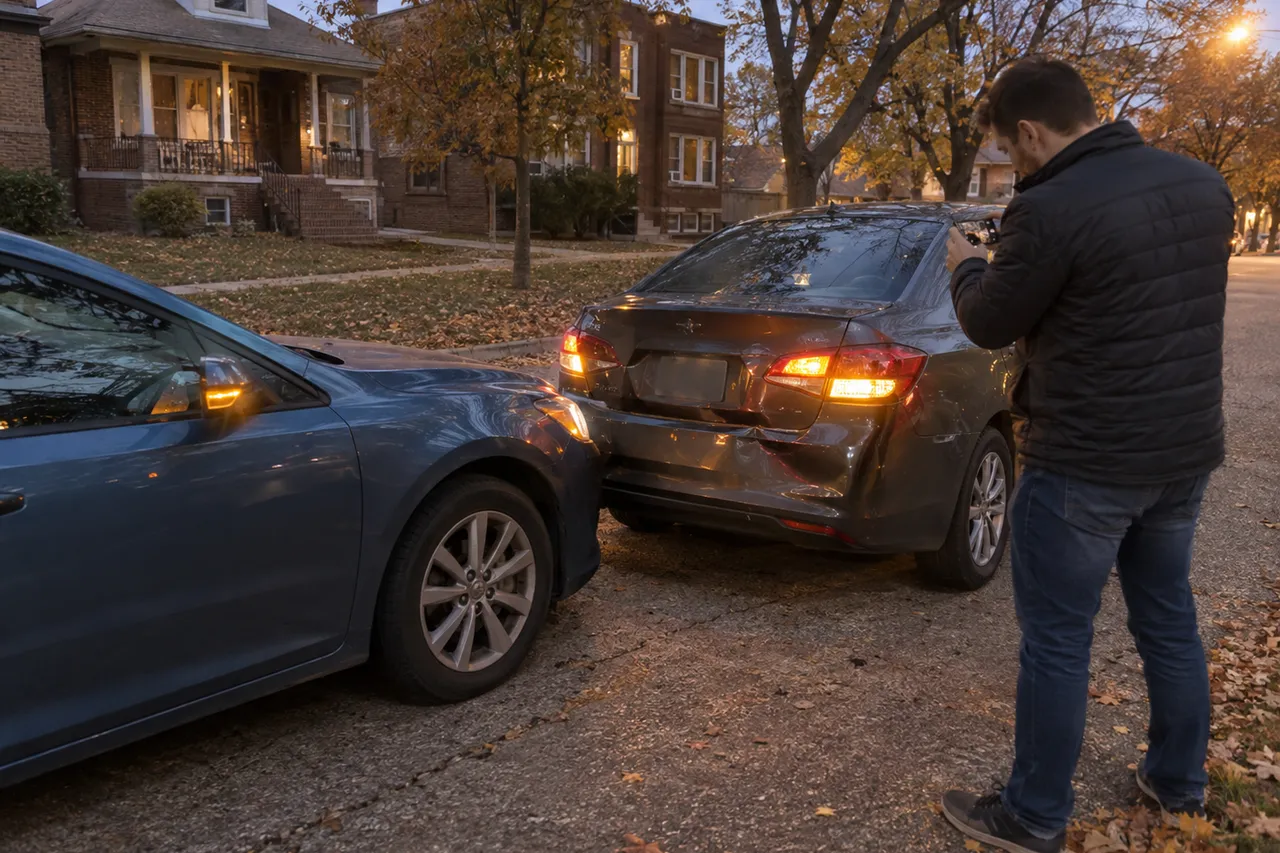
Quick answer: Illinois requires uninsured motorist bodily injury (UM) coverage on every auto policy, at least $25,000 per person and $50,000 per accident. It pays for your injuries when a driver with no insurance, or a hit-and-run driver, is at fault. If you choose higher UM limits, Illinois also requires underinsured motorist (UIM) coverage at the same limits. With roughly one in seven Illinois drivers uninsured, most Chicago drivers should match their UM and UIM limits to their own liability limits and consider adding uninsured motorist property damage (UMPD) for their car.
It is one of the most common calls we get at our Bucktown office: a client was rear-ended on Milwaukee Avenue or sideswiped on the Kennedy, and the other driver had no insurance, or just the state minimum. What happens next depends almost entirely on a few lines of your own policy that most people never look at. Here is how uninsured and underinsured motorist coverage works in Illinois, and how to set it up before you need it.
How Many Illinois Drivers Are Uninsured?
The Insurance Research Council estimates that about 15.2% of Illinois drivers were uninsured in 2023, ranking the state 17th highest in the country. Nationally, the same research found that one in three drivers was either uninsured or underinsured. In a dense city with heavy traffic, those odds add up quickly.
Driving without insurance is illegal in Illinois and can bring fines and a suspended registration, but that does not pay your medical bills. Rising premiums have pushed some drivers to drop coverage or buy the bare minimum, which is one reason we covered why Illinois premiums have climbed and how to manage rising insurance costs.
What Illinois Law Requires
Every Illinois auto policy must carry at least:
- Bodily injury liability: $25,000 per person and $50,000 per accident.
- Property damage liability: $20,000 per accident.
- Uninsured motorist bodily injury: $25,000 per person and $50,000 per accident.
- Underinsured motorist bodily injury: required at the same limits as your UM coverage whenever your UM limits are higher than the state minimum.
Those minimums were set for a different era of medical costs. A single trip to the emergency room, a few weeks of physical therapy, and lost wages can pass $25,000 fast. Our auto insurance 101 guide walks through every coverage on a typical policy.
Uninsured vs. Underinsured Motorist Coverage
These two coverages work together but solve different problems:
- Uninsured motorist (UM) pays for injuries to you and your passengers when the at-fault driver has no liability insurance, or when the driver is a hit-and-run who cannot be found.
- Underinsured motorist (UIM) pays when the at-fault driver has insurance, but not enough. In Illinois, it pays the difference between your UIM limit and the other driver's liability limit.
Here is how UIM plays out. Say you carry $100,000 in UIM coverage and are seriously injured by a driver with the $25,000 minimum. After their insurer pays $25,000, your UIM can pay up to another $75,000. If you only carried the minimum $25,000 UM and no extra UIM, there would be nothing more to collect from your own policy, and you would be left trying to recover the rest from the other driver personally.
What Uninsured Motorist Coverage Pays For
Uninsured and underinsured motorist bodily injury coverage can help pay for:
- Medical and hospital bills for you and your passengers
- Physical therapy and ongoing treatment
- Lost wages while you recover
- Pain and suffering, and in the worst cases, wrongful death claims
It generally protects you and household members even as pedestrians or cyclists, which matters on busy Chicago streets like Milwaukee, Damen, and Elston where bikes and cars share the road. Policies vary, so ask us how yours reads.
What About Damage to Your Car?
UM and UIM bodily injury do not fix your car. For vehicle damage caused by an uninsured driver, you have two options:
- Uninsured motorist property damage (UMPD): an optional coverage that pays for damage to your car caused by an identified, at-fault, uninsured driver. Illinois requires insurers to offer it with a deductible of no more than $250, and you can buy it with or without collision coverage.
- Collision coverage: pays for damage to your car regardless of fault, including when the other driver is uninsured or unknown, subject to your collision deductible.
If you carry collision with a $1,000 deductible, UMPD can still be worth it for the lower deductible when the uninsured driver is known. If you dropped collision on an older car, UMPD may be the only thing standing between you and paying for repairs yourself.
Hit-and-Run Accidents in Chicago
Hit-and-runs are an unfortunate part of city driving and city parking. For injuries, Illinois treats a hit-and-run driver much like an uninsured driver, so your UM coverage can respond. A few rules matter:
- Physical contact. Policies usually require that the other vehicle actually hit you or your car. A driver who runs you off the road without touching your car can be harder to claim against.
- Report it right away. Call 911 or file a police report promptly, and notify your insurer as soon as you can.
- Your car is a collision claim. UMPD does not apply when the hit-and-run driver cannot be identified, so damage to your parked or moving car falls under collision coverage.
Our step-by-step guide to filing an insurance claim in Illinois covers documentation habits that help with auto claims too.
How Much Uninsured Motorist Coverage Should You Carry?
Our general rule: match your UM and UIM limits to your own liability limits. If you carry 100/300 liability to protect other drivers, you deserve the same 100/300 protection for yourself and your family. Raising UM and UIM from the minimum is usually one of the least expensive upgrades on an auto policy.
- Higher limits make sense if you have a long commute, drive for a rideshare service, often carry passengers, or have a family that depends on your income.
- Health insurance is not a substitute. It will not replace lost wages or pay for pain and suffering, and it may have high deductibles.
- Ask about your umbrella. Some personal umbrella policies can add uninsured and underinsured motorist coverage, and some exclude it. It is worth checking.
If you are adding a new driver this year, our guide to teen drivers and auto insurance is a good companion read.
What to Do If an Uninsured Driver Hits You
- Check for injuries and call 911 if anyone is hurt.
- Call the police and get a report number, even for a minor crash.
- Photograph both cars, the plate, the scene, and the other driver's license if they will show it.
- Get names and phone numbers from any witnesses.
- See a doctor promptly, even if you feel fine.
- Notify your insurer quickly and tell them the other driver may be uninsured.
- Keep every medical bill, receipt, and record of missed work.
- Call your agent before you sign anything or give a recorded statement to the other side.
Your Uninsured Motorist Coverage Checklist
- Find your UM and UIM limits on your declarations page.
- Compare them with your bodily injury liability limits.
- Raise UM and UIM to match your liability limits if they are lower.
- Check whether you carry UMPD, and at what deductible.
- Decide whether collision still makes sense for each car.
- Ask whether your umbrella policy adds UM and UIM coverage.
- Keep your insurer's claim number and your agent's number in your phone.
- Review your coverage again at every renewal.
The Bottom Line
Uninsured and underinsured motorist coverage protects you from other people's decisions. In a state where roughly one in seven drivers has no insurance and many more carry only the minimum, it is one of the most valuable lines on your policy and one of the cheapest to improve. If you are comparing carriers, our guide to the best auto insurance for Chicago drivers and our tips on when to reshop can help.
As an independent insurance agency in Chicago, we compare car insurance and home and auto bundles from multiple carriers and show you exactly what higher UM and UIM limits would cost. Contact Six Corners Insurance for a free auto policy review.
Sources
- Illinois Department of Insurance — Auto Insurance Definitions
- Illinois Department of Insurance — Auto Insurance Shopping Guide
- Illinois General Assembly — 215 ILCS 5/143a (Uninsured motorist coverage)
- Illinois General Assembly — 215 ILCS 5/143a-2 (Underinsured motorist coverage)
- Insurance Information Institute — Facts + Statistics: Uninsured Motorists
- National Association of Insurance Commissioners — Auto Insurance
Frequently Asked Questions
Is uninsured motorist coverage required in Illinois?
Yes. Every Illinois auto policy must include uninsured motorist bodily injury (UM) coverage of at least $25,000 per person and $50,000 per accident. If you buy UM limits higher than that minimum, Illinois law also requires underinsured motorist (UIM) coverage at the same limits.
How many Illinois drivers are uninsured?
The Insurance Research Council estimates that about 15.2% of Illinois drivers were uninsured in 2023, roughly one in seven, which ranked Illinois 17th highest in the country. Many more carry only the state minimum limits, which is why underinsured motorist coverage matters too.
Does uninsured motorist coverage pay for damage to my car?
Not the bodily injury part. Damage to your car from an uninsured driver is covered by uninsured motorist property damage (UMPD), an optional coverage, or by your own collision coverage. In Illinois, UMPD only pays when the at-fault uninsured driver is identified, and insurers must offer it with a deductible of no more than $250.
Does uninsured motorist coverage cover a hit-and-run in Chicago?
For injuries, generally yes. Illinois treats a hit-and-run driver like an uninsured driver for bodily injury claims, but policies usually require actual physical contact with the other vehicle. Report the crash to police right away and notify your insurer quickly. Damage to your car from an unidentified hit-and-run driver is a collision claim, not a UMPD claim.
How much uninsured motorist coverage should I carry?
Most people should match their UM and UIM limits to their own liability limits. If you carry 100/300 liability, carrying 100/300 UM and UIM protects you and your passengers as well as you protect other drivers. The cost of raising UM and UIM limits is usually modest compared with the protection it adds.