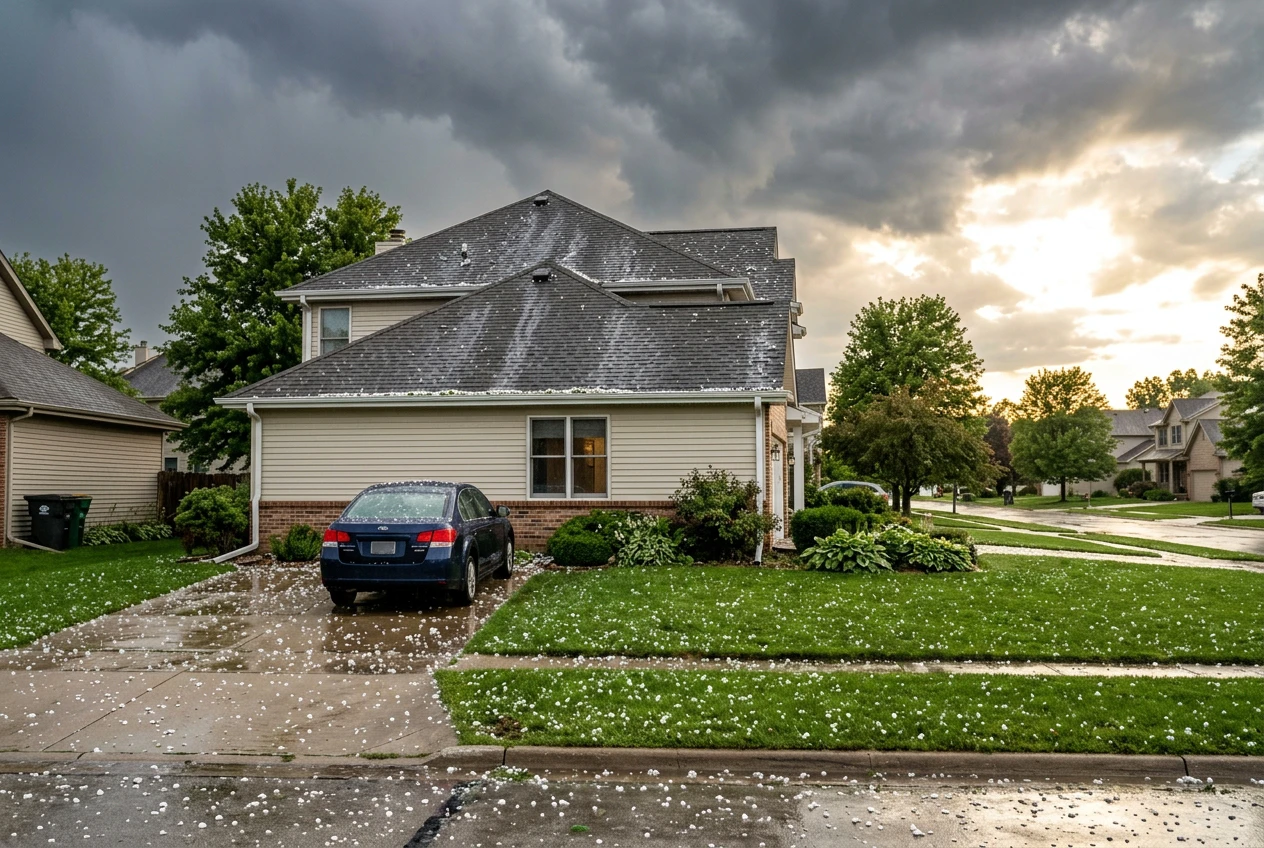
If you live in the Midwest, June isn't just the start of summer — it's the heart of severe storm season. Hail, straight-line winds, and the occasional derecho roll through Illinois, Indiana, Michigan, Minnesota, and Wisconsin every year, and they leave roofs, siding, and vehicles dented in their wake. Every summer our phones light up the day after a big storm with the same question: “Is this covered, and what do I do now?”
Here's a clear, practical walkthrough — what your homeowners policy actually covers, how to document damage, and how to file a claim without leaving money (or coverage) on the table.
Why the Midwest Gets Hit So Hard
Our region sits in a corridor where warm, humid air from the Gulf collides with cooler air moving down from Canada. That clash is a hail factory. Parts of the upper Midwest now see more billion-dollar hail and wind events than almost anywhere outside the traditional Plains “hail alley.” This is also a big part of why home insurance rates keep climbing across the Midwest — carriers are paying out more storm claims than ever.
What Your Homeowners Policy Typically Covers
The good news: standard homeowners policies in our footprint cover wind and hail damage as named perils. That generally includes:
- Roof damage from hail impact or wind-lifted shingles
- Siding, gutters, and windows dented, cracked, or torn off
- Interior water damage that results from a storm-created opening (a tree through the roof, for example)
- Detached structures like sheds, fences, and detached garages (usually under “other structures” coverage)
- Personal property damaged when the storm breaches the home
- Additional living expenses if the damage makes your home temporarily uninhabitable
One important note: damage to your vehicle from hail is not covered by your homeowners policy — that falls under the comprehensive portion of your auto insurance. If a storm dents both your roof and your car, you may be filing two separate claims with two separate deductibles.
Where Coverage Gets Complicated
This is where homeowners get surprised. A few things to understand before a storm hits:
- Actual cash value vs. replacement cost on the roof. Many policies — especially newer ones in storm-prone areas — now settle roof claims on an actual cash value (ACV) basis for roofs over a certain age. That means depreciation gets subtracted, and you could be responsible for thousands more than you expected. Check whether your roof is on replacement cost or ACV. This single line item matters more than almost anything else in your policy.
- Separate wind/hail deductibles. Some carriers apply a percentage deductible (often 1–2% of your dwelling coverage) for wind and hail instead of a flat dollar amount. On a $400,000 home, a 2% wind/hail deductible is $8,000 — not the $1,000 you might assume.
- Cosmetic damage exclusions. A growing number of policies exclude “cosmetic” hail damage to metal roofs and siding — dents that don't affect function. Worth knowing where your policy stands.
- Maintenance vs. storm damage. Adjusters distinguish between sudden storm damage (covered) and wear, age, or poor maintenance (not covered). Good documentation is how you stay on the right side of that line.
What to Do Immediately After a Storm
- Make sure everyone is safe and stay clear of downed power lines and unstable structures.
- Document everything before you clean up. Take wide photos and close-ups of all damage — roof (from the ground or a drone, don't climb up in unsafe conditions), siding, windows, gutters, and any interior water intrusion. Date-stamp them.
- Make temporary repairs to prevent further damage. Tarp the roof, board a broken window, move valuables away from leaks. Keep your receipts — these costs are usually reimbursable. Do not make permanent repairs until the adjuster has seen the damage.
- Note the date and time of the storm. Carriers cross-reference hail and wind reports by location and date, so an accurate timeline helps your claim move faster.
- Call us before you call a roofer. More on that below.
A Word of Caution on Storm-Chasing Contractors
After every major hailstorm, out-of-town contractors flood the affected neighborhoods knocking on doors, offering “free inspections” and promising to “handle your insurance for you.” Some are legitimate. Many are not. Be especially wary of anyone who:
- Pressures you to sign a contract or “assignment of benefits” on the spot
- Offers to waive or “eat” your deductible — this is insurance fraud in most states and can void your claim
- Has no local address, no local references, and a magnetic sign on the truck
- Wants a large deposit before any work begins
Our advice: call us first. We can help you understand your coverage, recommend reputable local contractors, and make sure the claim is filed correctly — before you sign anything.
How to File the Claim the Right Way
- Review your deductible first. If the damage is minor and close to your deductible, filing may not be worth it — too many small claims can affect your renewal. We can help you make that judgment call.
- File promptly. Most policies require “timely” notice. Don't wait weeks.
- Provide your documentation — photos, receipts for temporary repairs, and your timeline.
- Be present for the adjuster's inspection. Walk the property with them and point out everything. Having your own contractor's estimate on hand can help.
- Understand the settlement. If your roof is on replacement cost, you typically receive the ACV amount first, then the “recoverable depreciation” after the work is completed and invoiced. Don't leave that second check unclaimed.
State-by-State Notes
- Illinois. Chicago-area storms increasingly bring both hail and flash flooding — remember that flood and sewer backup are separate from wind/hail coverage. Ask us about adding water backup coverage if you don't have it.
- Indiana & Wisconsin. Both states see frequent straight-line wind events; make sure your “other structures” limit is high enough to cover detached garages, barns, and large fences.
- Michigan. Lake-effect dynamics can intensify summer storms; roof age and ACV settlement terms are especially common here, so check yours.
- Minnesota. One of the highest hail-claim states in the country. Percentage wind/hail deductibles are increasingly common — know yours before the storm, not after.
The Best Time to Check Your Coverage Is Now
The worst time to learn your roof is on actual cash value, or that you have a 2% wind/hail deductible, is the day after a storm. The best time is today — before the next system rolls through.
Send us your current declarations page and we'll do a quick storm-readiness review: we'll tell you whether your roof is on replacement cost or ACV, what your wind/hail deductible really is, and whether you have the water-backup and other-structures limits to match the way Midwest storms actually behave. No pressure, no obligation.
Reach out here or call or text us at (312) 651-6759. Stay safe out there this summer.