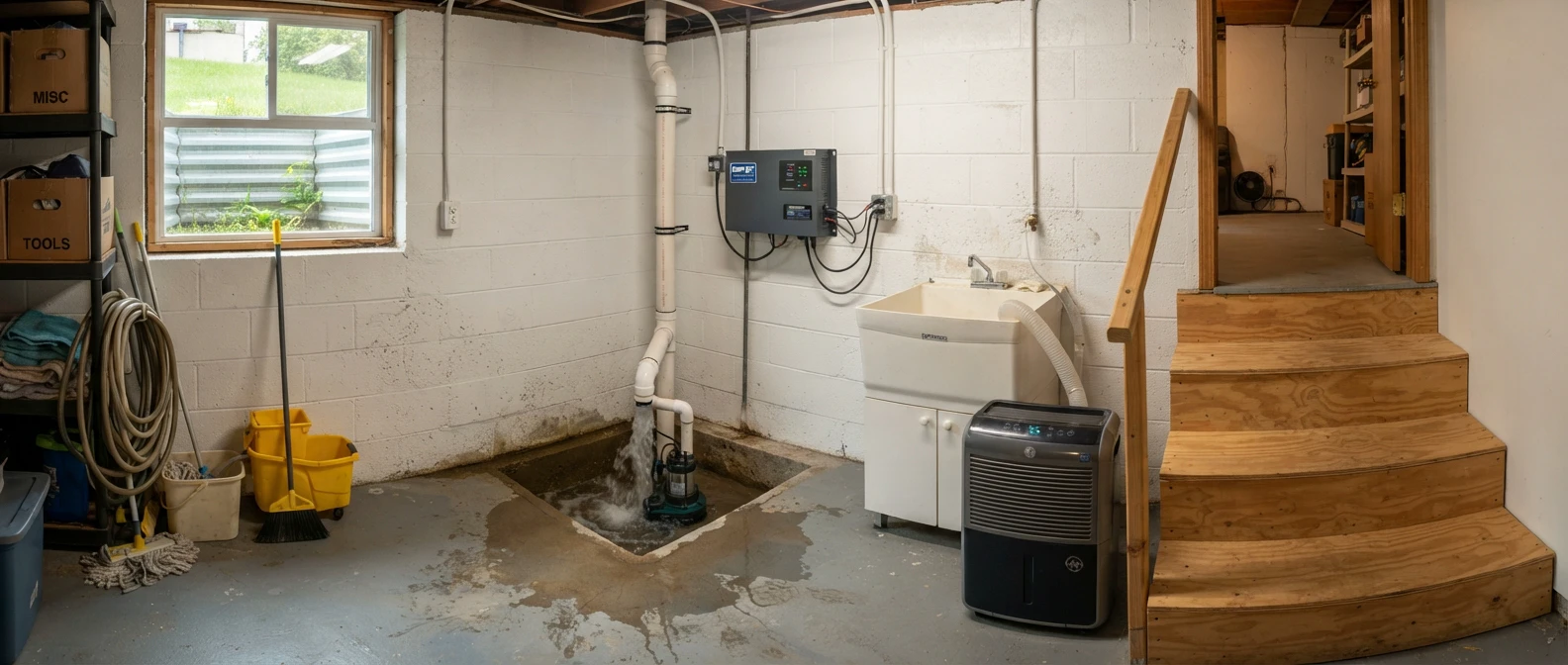
Every summer, after the first big multi-inch rain rolls through the Chicago area, our phones ring with the same call: “Our basement just filled up with water. Where did this come from, and is it covered?” The honest answer is the second-hardest part of the conversation — that for most homeowners in our footprint, the cause of the loss is the same as the reason it isn't covered. Sewer and sump pump backup losses aren't part of a standard homeowners policy. They're an add-on. And a lot of carriers, agents, and renewals quietly drop the rider when nobody asks about it.
This is the deep dive we put off in our recent post on hail and summer storm claims — where we mentioned that flood and sewer backup coverage is separate from wind and hail. Here's what you actually need to know.
The Most Common Basement Flood Is the One Your Policy Excludes
When people hear “flood,” they picture rivers overflowing their banks, or storm surges. That's true — but it's not what empties most Midwest basements. The losses we actually see year after year fall into a different category:
- Sewer backup: municipal lines overwhelm during a heavy rain and push sewage back up through basement floor drains, toilets, and showers.
- Sump pump failure: groundwater rises, the pump loses power, the float sticks, or the discharge line freezes or becomes blocked — and water finds the next easiest path into the home.
- Failed sump or drain line: a perforated or root-intruded sewer lateral between the house and the curb finally gives way during a sustained rain.
None of those events trigger standard flood coverage. And — critically — none of them are paid under the standard homeowners insurance policy in Illinois, Indiana, Michigan, Minnesota, or Wisconsin. Most homeowners don't learn that until after the wet vac is already running.
Why This Hits the Midwest So Often
Our region has a few built-in disadvantages:
- Aging municipal infrastructure. Chicago and many older inner-ring suburbs still operate combined sewer systems where storm runoff and household sewage share the same pipes. In a major rain, those pipes surcharge and push water back the only direction it can go — into homes. Combined sewer overflows (CSOs) are a fact of life across the lakefront, the Near West Side, and several of Chicago's older neighborhoods.
- A freeze-thaw cycle that quietly destroys private laterals. Clay tile and Orangeburg sewer laterals from the 1920s–1950s crack, offset, and partly collapse over decades. They usually hold — until a spring deluge when the ground is already saturated.
- A lot of homes with a basement. Illinois is one of the highest states in the country for percentage of homes with basements. A typical 2-flat in Bucktown, a vintage greystone in Logan Square, a 1950s ranch in Deerfield, or a split-level in Naperville all share the same exposure: square footage below grade that nobody wants to lose to a backup.
- Summer storms that dump more than the ground (or the pumps) can absorb. Back-to-back “training” thunderstorms — the kind that've become the norm in June and July — stress the whole drainage system at once.
Water Backup vs. Flood Coverage — They're Different Policies
Three different “wet basement” problems, three different insurance mechanisms. Most homeowners don't have any of them and assume their homeowners policy will respond. It won't.
- Flood insurance. Covers water rising from outside your home — riverine overflow, storm surge, surface flooding. Sourced through the National Flood Insurance Program (NFIP) or a private flood market. Cheap to buy in low-risk zones ($400–$900/yr in our area), mandatory with a mortgage in a high-risk flood zone. Does not cover backup through drains or sump pumps.
- Water backup & sump pump discharge coverage (a rider / endorsement on your homeowners policy). Covers water that enters your home through a sewer, drain, or sump pump. Available in tiered limits, typically $5,000 / $10,000 / $25,000. This is the one most should have.
- Ground seepage or hydrostatic pressure. Water that seeps through the foundation without going through a floor drain or sump is explicitly excluded by most carriers. Even a rider won't usually pay for that one.
If you read nothing else from this post, read this: check whether you have water backup coverage on your homeowners policy. If you can't find it on your declaration page, you don't have it.
What a Water Backup Rider Actually Covers
The endorsement is short and worth reading carefully. In plain terms, it pays for damage to your home and your contents from water that enters through:
- Sewer drains (the floor drain in the basement, the toilet, the standpipe next to the washer)
- Sump pump overflow or failure (power loss, stuck float, frozen/blocked discharge line)
- Septic system backup
It typically includes:
- Damage to the structure itself — drywall, flooring, base trim, finished walls
- Damage to mechanical systems — furnace, water heater, electrical panel, washer/dryer
- Personal property that got wet — furniture, electronics, stored items
- Removal and tear-out (the demo to dry out the wall cavity)
- Cleanup and sanitization, especially for sewer backups
It does not typically include:
- Damage to the sump pump itself (carriers consider that a maintenance issue)
- Ground seepage through the foundation wall or floor
- Flooding from outside water rising above grade
- Mold from long-term seepage (an ongoing maintenance issue)
- Often, foundation crack repair and structural drying beyond a stated number of days
How Much Coverage Should You Buy?
Here's where the math most homeowners get wrong. They buy the minimum $5,000 limit because the rider is cheap — $50 to $120 a year in most of our territory — and assume that's enough. It usually isn't.
A finished basement with a family room, half-bath, kids' play area, and laundry will run $50–$70 a square foot to rebuild after a backup. A modest 600-square-foot basement with a half-bath and a home office can mean:
- $8,000–$15,000 in drywall, trim, paint, flooring, and base replacement
- $1,500–$4,000 to rip out, dry out, and sanitize
- $4,000–$10,000 in damaged mechanicals (especially a furnace and water heater that sat in three inches of water)
- $5,000–$20,000 in contents (furniture, electronics, the kids' Lego collection, the family room sofa)
Most carriers in our region offer $5,000 / $10,000 / $25,000 limits. We usually recommend at least $10,000 for a home with a partially finished basement and $25,000 for a home with a fully finished basement below grade. The premium difference between $5,000 and $25,000 is almost always under $80 a year.
A Few Details Worth Checking on Your Declarations Page
When you pull out your homeowner's policy, here are the line items to look at — and the questions to ask us:
- Is the rider attached? If you don't see “water backup” or “sump pump discharge” listed as an endorsement, it isn't.
- What limit? Look at the dollar amount on the water-backup line.
- What deductible? Water backup deductibles are sometimes higher than your standard policy deductible — we've seen $1,000, $2,500, and even 1% of dwelling coverage in some markets.
- Is “equipment breakdown” included? If not, ask whether sump pump itself can be added. A failed pump typically costs $200–$1,500 to replace.
- Is “service line” coverage attached? That covers the part of the sewer line that runs from your house to the street — and it's the kind of repair (open-cut trench through the yard, possibly under the city sidewalk) that can run $5,000–$15,000 without warning.
- Is there coverage for “limited fungus, mold, and dry rot”? Standard policies cap this at $10,000 lifetime and exclude if it's been wet for more than 14 days. Worth knowing before you need it.
Reduce the Risk — Beyond Insurance
Insurance is the safety net. Here's the ladder:
- Install a battery or water-powered backup sump pump. Most sump pump losses we see are tied directly to a power outage during the storm. A $300–$900 battery backup unit pays for itself the first time the lights flicker for 20 minutes.
- Test the sump pump annually. Dump a bucket into the pit, watch the float, listen to the discharge, walk outside and confirm water's actually leaving the property.
- Make sure the discharge line is clear. Discharge lines terminate a few feet from the foundation. If yours is buried, ice-clogged, or pushing water back uphill, the pump is doing the equivalent of bailing out a boat with a hole in it.
- Install a backflow preventer (or convert to an overhead sewer). Common in city code right now for new construction, especially in CSO areas. Prevents surcharge water from re-entering the home.
- Get a simple water sensor and/or a smart water shut-off. $30 to $250 hardware, can detect and stop a small leak before it becomes a half-inch of standing water.
- Re-grade the yard if it slopes toward the foundation. A foot of fall over six feet saves more headaches than almost any gadget.
- Replace an aging sewer lateral proactively. If you're already redoing the yard or driveway, that's the cheapest time to address a 70-year-old clay tile line you can't see.
State-by-State Midwest Notes
- Illinois. Chicago's combined sewer system means basement backups are common across most of the city and inner-ring suburbs — North Center, Lincoln Park, Bucktown, Logan Square, Hyde Park, and the Near West Side in particular. If you live within the city, a $25,000 water backup limit strongly aligns with what a single event can cost.
- Indiana. Many homes near Lake Michigan sit on high water tables and sump pumps run year-round. Pump failure in the middle of a January cold snap is a regular winter claim.
- Michigan. Several counties (Wayne, Oakland, Macomb) have some of the highest sump pump failure claims in the country. Many carriers effectively treat working sump pumps as a basic maintenance requirement here.
- Minnesota. Spring snowmelt plus saturated clay soils plus a heavy June rain equals a backup-prone spring and summer. Many Minnesota underwriters want to know sump pump age and battery backup before issuing or renewing.
- Wisconsin. The frost line runs deep; frost-heaved laterals and frozen discharge lines are real, and the first warm thunderstorm after a long cold snap is one of the worst-case scenarios in the upper Midwest.
The Coverage Worth Checking Once a Year
The least expensive addition you can make to your homeowners policy is also one of the most expensive to not have. A water backup rider rarely costs more than a nice dinner for two, and a single backup event can run five figures in a single afternoon — none of it paid by the policy unless the endorsement is sitting on your declarations page.
Send us a copy of your current HO-3 declarations page (or just the first two pages). We'll tell you whether your water backup endorsement is attached, what the limit is, whether service line and equipment breakdown are in play, and whether any of the local risk factors above suggest raising your limit. No pressure, no obligation.
Reach out here, or call or text us at (312) 651-6759. Stay dry out there this summer.