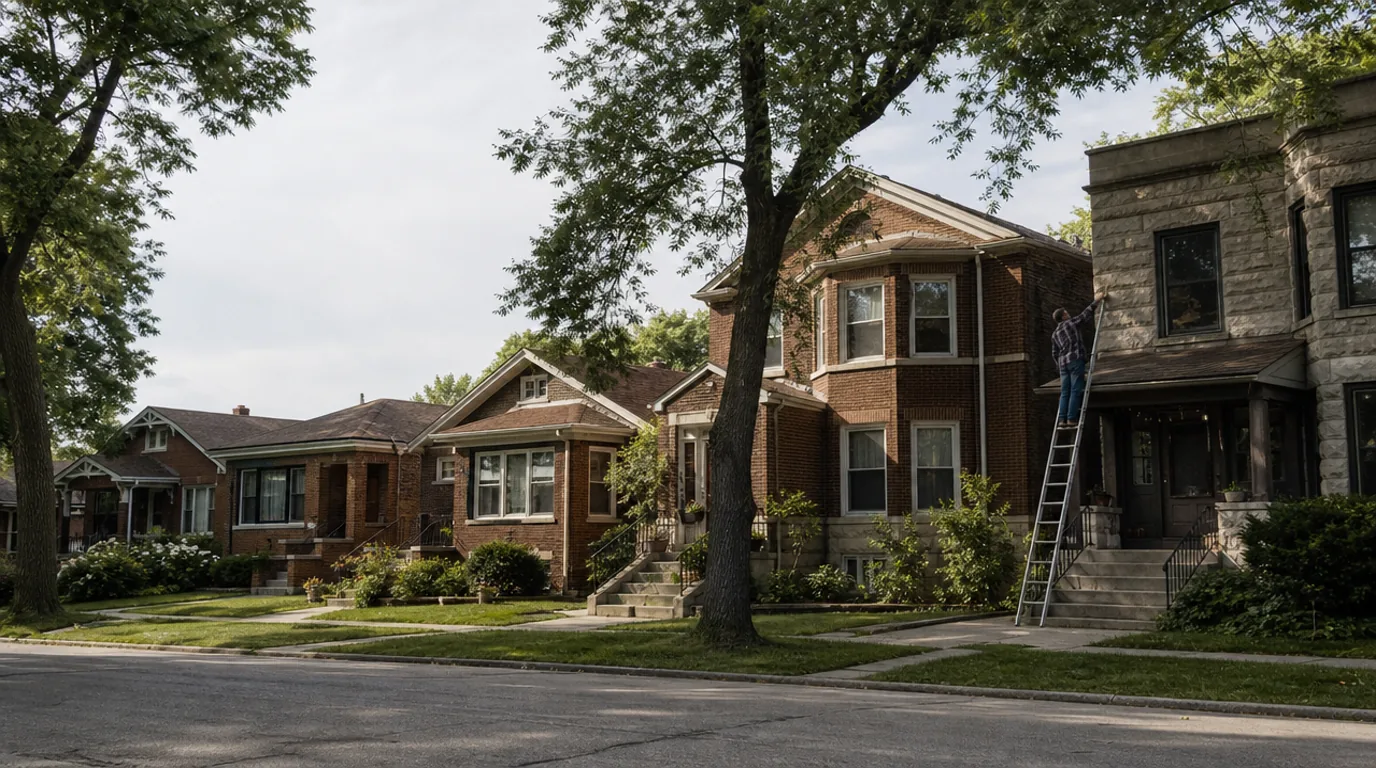
Search for the best homeowners insurance for an older home in Chicago and you'll get a list of national brand names ranked by somebody's star system. That's not wrong, exactly — but it misses the point. For a 1920s brick bungalow in Portage Park, a greystone in Logan Square, or a two-flat in Albany Park, the “best” policy isn't a brand. It's a specific set of coverage decisions that fit how older Chicago housing stock actually fails.
Here's the honest version: older homes cost more to insure, some carriers won't write them at all, and the difference between a good policy and a cheap one usually doesn't show up until a claim. This guide covers what to look for, what to ask, and why the same house can get very different answers from different carriers.
Why Older Chicago Homes Are Underwritten Differently
Carriers price risk, and older construction carries risks a new build doesn't. When an underwriter looks at an older Chicago home, they're usually thinking about four systems:
- Roof age. A roof past 15–20 years can limit which carriers will write the policy, raise the premium, or change how a hail or wind claim gets paid. Some carriers settle older roofs at actual cash value (depreciated) instead of full replacement cost — a difference that can be thousands of dollars on a single storm claim.
- Electrical. Knob-and-tube wiring, old fuse boxes, and 60-amp service are red flags. Many carriers will still write the home, but some require an update or an inspection first.
- Plumbing. Galvanized steel supply lines and original cast-iron drains mean higher odds of a water loss — the most common homeowners claim there is.
- Heating and masonry. Aging boilers, older furnaces, and unreinforced or tuckpointed- decades-ago brick all factor into pricing and eligibility.
None of this means your home is uninsurable. It means the “best” carrier for your neighbor's 2015 new construction may be the wrong answer for your 1925 bungalow — and vice versa.
What “Best” Actually Means for an Older Home
Instead of ranking logos, rank the policy features. For older Chicago homes, these are the ones that matter most:
1. Replacement Cost on the Dwelling — at a Realistic Amount
Older homes often cost far more to rebuild than their market value suggests, because plaster, millwork, masonry, and vintage materials don't have cheap modern equivalents. If your dwelling limit is based on what you paid for the house rather than what it would cost to reconstruct it, you can be underinsured by six figures without knowing it. Look for replacement cost coverage with an extended or guaranteed replacement cost endorsement on top.
2. Ordinance or Law Coverage
This is the quiet one, and for older Chicago homes it may be the most important line on the policy. If your home is damaged and current building code requires upgraded electrical, plumbing, or structural work during the rebuild, a standard policy pays to restore what was there — not to bring it up to code. Ordinance or law coverage pays that difference. On a century-old home, that gap can be enormous, and the base amount included in many policies (often 10% of the dwelling limit) may not be enough.
3. Roof Settlement Terms in Writing
Ask directly: if hail destroys my roof, do you pay replacement cost or actual cash value? With Midwest hail season doing what it does, this single answer can matter more than $200 of premium difference between quotes.
4. Water Backup and Service Line Coverage
Older Chicago homes have older sewers, older laterals, and basements that see water. Two optional endorsements do the heavy lifting here, and they're different: water backup covers water or sewage that comes up through drains and sumps, and service line coverage pays to excavate and repair the buried lines you own. We wrote separate deep-dives on water backup coverage in Illinois and service line coverage for Chicago homeowners because these gaps surprise people constantly.
5. A Carrier That Actually Wants Older Homes
Some carriers compete hard for well-maintained older housing stock. Others write it reluctantly and price accordingly. This is the part a ranking website can't tell you, because appetite changes by ZIP code, by year, and by the specific updates your home has had.
What to Have Ready Before You Shop
You'll get better answers — and better pricing — if you can answer these questions up front:
- Roof: age, material, and date of last replacement or repair
- Electrical: panel type and amperage, and whether any knob-and-tube remains
- Plumbing: supply line material (copper, PEX, or galvanized) and whether the sewer has been scoped or lined
- Heating: furnace or boiler age and type
- Updates: any permitted renovations, with approximate years
Documentation matters here. Permits, invoices, and inspection reports turn an underwriter's “unknown” into a “verified,” and verified risk prices better.
Why an Independent Agent Has an Edge With Older Homes
A captive agent sells one carrier's appetite. If that carrier doesn't like your roof age or your fuse box, the answer is a higher price or a no. An independent agency represents multiple carriers with different appetites, so the same house gets shopped across companies that actually want it. That's not a sales line — it's how the independent agent model works, and it matters more for older homes than almost any other property type.
The Real Answer to “What's the Best Policy?”
For an older Chicago home, the best homeowners insurance is the one with full replacement cost on the dwelling, meaningful ordinance or law coverage, replacement-cost roof settlement, water backup and service line endorsements, and a carrier whose underwriting appetite matches your home's actual condition — at a premium you can sustain year after year.
Send us your current declarations page and we'll tell you plainly where it stands against that list. If you're not sure what your policy even says, start with our homeowners insurance 101 guide, then reach out here or call or text us at (312) 651-6759.
Frequently Asked Questions
What is the best homeowners insurance for an older home in Chicago?
The best policy for a Chicago bungalow, greystone, or two-flat combines full replacement cost on the dwelling, meaningful ordinance or law coverage, replacement-cost roof settlement, and water backup and service line endorsements — from a carrier whose underwriting appetite matches the home’s actual condition.
What is ordinance or law coverage?
Ordinance or law coverage pays the extra cost of rebuilding an older home to current building codes after a covered loss — including required upgrades to electrical, plumbing, and structural elements. Without it, those code-mandated costs come out of your pocket.
Why do insurers treat older homes differently?
Older homes often have aging roofs, original electrical or plumbing, and outdated heating systems, which raise both the likelihood and the cost of claims. Carriers may inspect the home, request updates, or settle roof claims at actual cash value instead of replacement cost.
Does homeowners insurance cover sewer backup in Chicago?
Typically no — water that backs up through a drain or sump pump is excluded on a standard policy unless you add a water backup endorsement. For older Chicago homes with aging drains, that endorsement is one of the most important add-ons to consider.