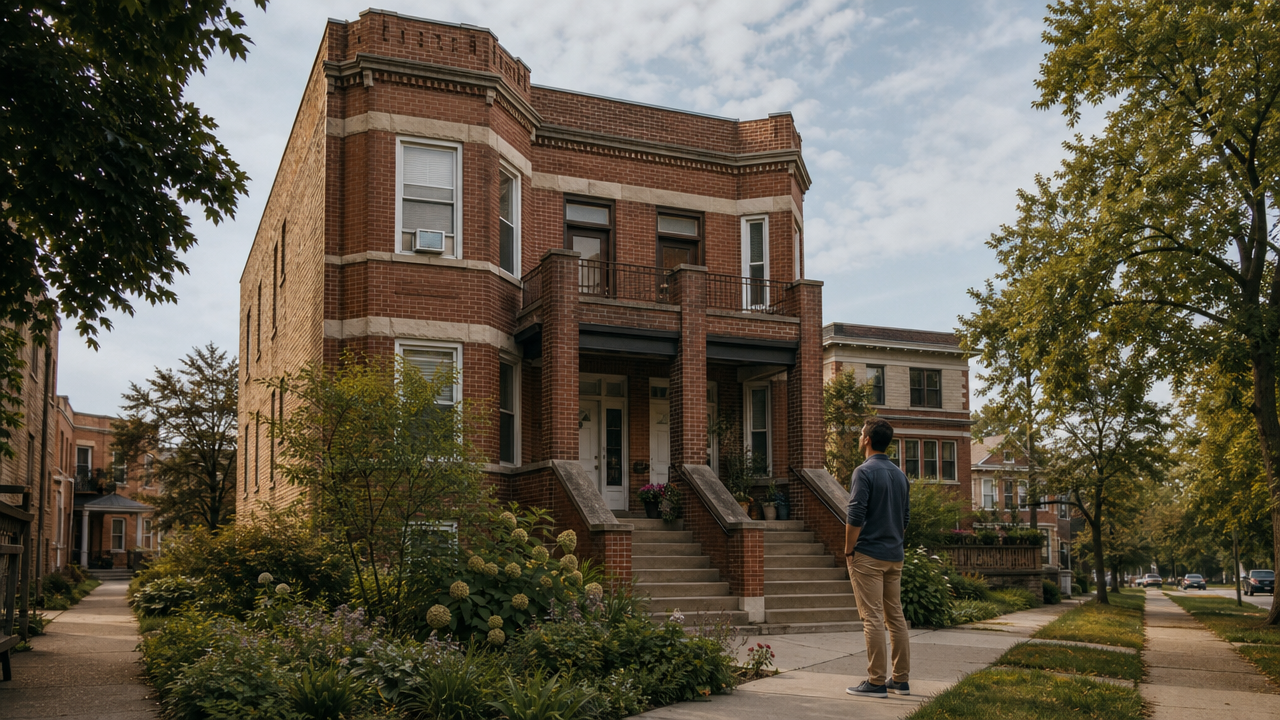
Quick answer: The right insurance for a Chicago two-flat starts with who lives in each unit. If you live in one unit and rent the other, the policy needs to reflect an owner-occupied two-family property. If tenants occupy both units, you will usually need a rental dwelling or landlord policy. In either case, the building, rental income, liability, owner’s contents, and water-related risks need to be reviewed separately.
Two-flats are one of the most useful property types in Chicago: you can live in one unit, rent the other, and build flexibility into the property. They are also easy to insure incorrectly. A standard single-family homeowners policy, a landlord policy, and an owner-occupied multi-unit policy are not interchangeable just because they cover the same brick building.
Here is the practical way to think about coverage before you buy a two-flat, move out, add a tenant, or renew the policy you already have.
The Policy Starts With Who Lives There
Insurance companies price and underwrite a building based on how it is used. An owner living on the premises presents a different risk from a building occupied entirely by tenants. A long-term rental is different from a short-term rental. A vacant unit is different from an occupied one.
That is why the first question on a two-flat quote should not be “Which company is cheapest?” It should be “What is the actual occupancy?” Be specific about:
- Whether you live in the upper or lower unit
- Whether the other unit has a long-term tenant
- Whether both units are rented while you live elsewhere
- Whether either unit is furnished or used for short-term stays
- Whether a unit is vacant between tenants
If the property changes from your residence to a full-time rental, tell your agent before the change. Do not assume the policy will automatically follow the building into its new use.
Owner-Occupied Two-Flat Coverage
When you live in one unit and rent the other, the policy needs to protect both your residence and your role as a landlord. Some carriers offer coverage designed for an owner-occupied two-family property; others may have different eligibility rules or require a different policy form.
Your own unit and belongings are one part of the conversation. The rented unit, the shared building systems, your responsibility as the property owner, and the rent you could lose after a covered loss are separate questions. The policy should describe the entire building, not just the unit where you sleep.
This is especially important in older Chicago housing stock. A policy that looks fine for a newer single-family home may not be the best fit for a two-flat with an older roof, original plumbing, aging electrical, or a basement shared by both units. Our guide to insuring older Chicago homes explains why replacement cost, ordinance or law coverage, and water endorsements deserve extra attention.
When the Building Is Fully Rented
If you live somewhere else and tenants occupy both units, the building is being used as a rental property. A landlord or rental dwelling policy is generally the right starting point for a long-term rental, rather than leaving a personal homeowners policy unchanged.
Landlord policies commonly address:
- The building. Coverage for covered physical damage to the structure and certain attached or other structures on the property.
- Owner-owned contents. Appliances, maintenance equipment, or furnishings you leave for tenant use may need to be listed and covered separately from your personal belongings.
- Liability. Protection for claims alleging that a tenant or guest was injured or that the owner was responsible for property damage, subject to the policy.
- Lost rental income. Coverage that may replace rent or fair rental value when a covered loss makes a unit uninhabitable, within the policy’s limits and time period.
The tenant’s property is not part of your landlord coverage. Furniture, clothing, electronics, and other personal belongings in the rented unit belong on the tenant’s renters policy. We explain that distinction in our Chicago landlord insurance guide.
The Coverage Checklist for a Chicago Two-Flat
1. Building replacement cost
The amount you paid for a two-flat is not the same as the cost to rebuild it. Reconstruction may involve demolition, labor, masonry, plaster, millwork, permits, and materials that are more expensive than their modern equivalents. The dwelling limit should be based on a realistic reconstruction estimate, not market value or the remaining mortgage balance; the NAIC consumer guide explains the difference between replacement cost and actual cash value.
2. Ordinance or law coverage
After a major loss, current building requirements can add costs that were not part of the original construction. Ordinance or law coverage can help address some code-required upgrades, such as electrical, plumbing, or structural work, when a covered loss triggers the rebuild. Older two-flats deserve a close look at both the included amount and whether a higher limit makes sense.
3. Loss of rent or fair rental value
If a fire or another covered loss makes the tenant’s unit unlivable, the rent may stop while repairs continue. Ask how the policy defines lost rental income or fair rental value, what expenses are included, and how long payments can continue. A limit that looks adequate for a short repair may not be enough after a large loss.
4. Premises liability
A two-flat owner can face liability questions involving steps, porches, sidewalks, common areas, snow and ice, maintenance, or conditions inside a rented unit. The right liability limit depends on the property, your assets, and your broader insurance program. If you are considering an umbrella, ask how rental property and landlord activity are treated rather than assuming the umbrella automatically applies.
5. Water backup and service lines
Basement water can involve more than one coverage. Water or sewage backing up through a drain or sump may require a water-backup endorsement. A buried sewer or water line may require service-line coverage for excavation and repair. Neither endorsement should be treated as a substitute for the other. See our guides to sump pump and sewer backup coverage and Chicago service line coverage.
6. Owner-owned equipment and furnishings
If you provide a refrigerator, range, washer, dryer, lawn equipment, or other items for tenant use, ask where those items are covered and whether there are special limits. Keep a simple inventory with photos, purchase records, and serial numbers for anything expensive or difficult to replace.
Common Two-Flat Claim Scenarios
| Situation | Coverage question |
|---|---|
| A kitchen fire damages one unit and smoke travels through the building | Building damage, contents, liability, and possibly lost rent may all need to be evaluated. |
| A tenant’s belongings are destroyed in the fire | The tenant’s renters policy is the place to look for their personal property. |
| Sewage backs up into a shared basement | Water-backup coverage, its limit, and the source of the water become important. |
| An underground sewer line collapses under the front walk | Service-line coverage may be relevant to excavation, repair, and surface restoration. |
| A tenant or guest is injured on a stairway or porch | Premises liability and the policy’s exclusions, limits, and maintenance conditions matter. |
| One unit is listed for short-term stays | Short-term rental activity needs to be disclosed and may require different coverage. |
What Changes When You Move Out
Many two-flat owners start as owner-occupants and later move for work, buy another home, or decide to rent both units. That is a major insurance event even if the building itself has not changed.
Before the move, tell your agent:
- When you will stop living in the building
- Whether one or both units will be rented
- Whether the tenants will have long-term leases
- Whether the building will be vacant between occupants
- Whether you will leave appliances, furniture, or maintenance equipment behind
A short-term rental brings another set of questions. Regular stays through a home-sharing platform can be treated as a business activity, and a standard homeowners policy may exclude or limit coverage for paying guests. Get the insurance answer before you accept a reservation.
Questions to Have Ready Before You Shop
A quote will be more accurate when you can provide the details carriers use to understand the building:
- Year built, square footage, construction, and roof age
- Electrical, plumbing, heating, and major renovation updates
- Which unit you occupy and how the other unit is used
- Current monthly rent and lease length
- Who maintains the stairs, sidewalks, yard, and shared utilities
- Whether the basement is finished, shared, or used for tenant storage
- Prior claims, vacancies, short-term rental activity, or property management arrangements
These details are not paperwork for its own sake. They determine which carriers will consider the property, how the building is valued, and which endorsements can close the most important gaps.
The Bottom Line
Chicago two-flat insurance is not just homeowners insurance with an extra unit added. The right policy matches the building’s actual occupancy and protects the risks that come with being both a homeowner and a landlord: replacement cost, code upgrades, lost rent, liability, owner-owned contents, water backup, and underground service lines.
We compare options for owner-occupied two-flats and rental properties across Chicago. Send us your current declarations page or the property details, and we will walk through what is covered, what is missing, and which policy structure fits the way you actually use the building. Reach out here, or call or text us at (312) 651-6759.
Sources
Frequently Asked Questions
Do I need landlord insurance if I live in one unit of a Chicago two-flat?
Not automatically. The right policy depends on the building, how the second unit is rented, and the carrier’s underwriting rules. Tell your agent that you live in one unit and rent the other so the policy is built for the actual use.
Can a standard homeowners policy insure a Chicago two-flat?
Sometimes, when the owner lives in the building and the carrier accepts that type of property. A fully tenant-occupied building generally needs a rental dwelling or landlord policy. The property’s occupancy and policy form should match before a loss occurs.
Does landlord insurance cover my tenant’s belongings?
No. A landlord policy protects the building and the owner’s financial interest in it. Your tenant’s furniture, clothing, electronics, and other belongings need to be covered by the tenant’s renters insurance policy.
Does two-flat insurance cover lost rent after a fire?
Many landlord and rental dwelling policies include coverage for lost rental income or fair rental value when a covered loss makes the rented unit uninhabitable. The limit, waiting period, covered causes, and payment period depend on the policy.
What if I rent one unit of my two-flat on Airbnb?
Tell your insurance agent before listing it. Short-term rentals can be treated differently from a normal long-term tenancy, and a standard homeowners policy may exclude or limit coverage for paying guests. A specific endorsement or different policy may be needed.