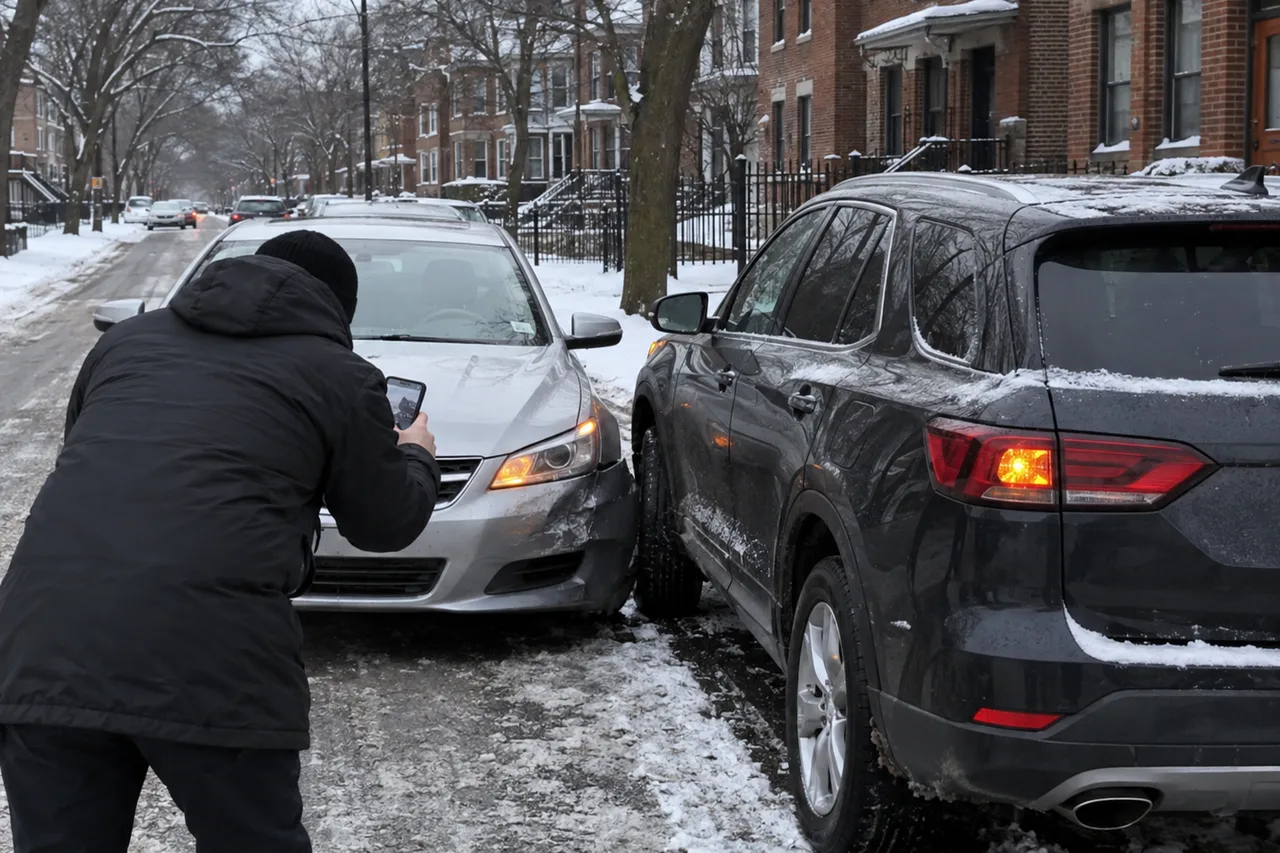
Quick answer: After a car accident in Chicago, stop, turn on your hazard lights, check for injuries, and call 911 if anyone is hurt. If the cars can move and no one is injured, move them out of traffic. Exchange names, addresses, plate numbers, and insurance with the other driver, take photos, and get witnesses’ contact information. Illinois law requires you to notify police when a crash causes injury or more than $1,500 in damage, and drivers no longer file a separate report with the state. Then report the accident to your insurance agent or company the same day, before you agree to anything with the other driver’s insurer.
A crash is stressful even when nobody is hurt, and the first hour decides a lot about how smoothly the claim goes. Winter is when we get the most of these calls at our Bucktown office: a rear-end on an icy Milwaukee Avenue, a sideswipe on a narrow side street lined with parked cars and snowbanks, a hit-and-run on a car parked overnight. Here is what to do, step by step, under Illinois law, and how your insurance handles each part. Save it on your phone, or keep a printed copy in the glove box.
Step 1: At the Scene
- Stop. Illinois requires every driver in a crash to stop at or as close to the scene as possible. Leaving the scene of a crash with injuries is a felony.
- Make it safe. Turn on your hazard lights. On the Kennedy, Edens, Dan Ryan, or another expressway, Illinois law lets you move a car that only has damage to the nearest safe spot, like the shoulder, an exit ramp, or a side street, and exchange information there. Stay in your car with your seat belt on if you can’t get off the road safely.
- Check for injuries and call 911 if anyone is hurt, a driver seems impaired, or the cars are blocking traffic. Illinois drivers must give reasonable help to anyone injured, including getting them to medical care.
- Exchange information. The law requires each driver to give their name, address, registration number, and the vehicle owner, and to show their license if asked. Also get the other driver’s insurance company and policy number and their phone number.
- Take photos of both cars from several angles, the plates, the other driver’s license and insurance card, the street, signs and signals, skid marks, and the weather and road surface. Snow and slush can cover the evidence within minutes.
- Talk to witnesses and get their names and phone numbers. Note any storefront or doorbell camera that might have recorded the crash.
- Don’t argue about fault or apologize in a way that sounds like admitting it. Stick to the facts with the other driver and with police.
If you hit a parked car and can’t find the owner, Illinois law requires you to leave a note in a visible place with your name, address, plate number, and the owner of your car, and to notify police without unnecessary delay.
Step 2: Notify the Police and Get the Crash Report
If police do not come to the scene, Illinois law requires drivers to notify police right away when the crash caused an injury, a death, or more than $1,500 in property damage ($500 if any driver is uninsured). A single modern bumper with sensors can cost more than that to fix, so assume a police report is needed unless the scrape is truly minor.
| Where the crash happened | Who handles it | Getting the report |
|---|---|---|
| City streets, including Lake Shore Drive | Chicago Police Department | CPD Traffic Crash Reports online, or CPD Records at 3510 S. Michigan Ave. |
| Expressways in the Chicago area | Illinois State Police | ISP crash reports online. If no trooper came, you can file a desk report in person within 10 days. |
| Suburbs | Local police or county sheriff | The department that responded |
Write down the officer’s name and the report number before you leave. One change many drivers don’t know about: since 2021, Illinois drivers no longer have to send the Illinois Motorist Report to IDOT within 10 days. The police agency sends its report to the state instead. Older checklists online still tell you to file it.
Step 3: Get Checked by a Doctor
Neck, back, and head injuries often don’t show up until the next day. Getting checked promptly protects your health, and it creates a record that ties any injury to the crash. Your health insurance and any medical payments coverage on your auto policy can pay bills right away, before fault is settled. Illinois generally allows two years to file a personal injury lawsuit, so if you are seriously hurt, talk to an attorney well before then.
Step 4: Report the Claim
Call your agent or your insurer’s claims line the same day, even if you think the other driver will pay. Your policy requires prompt notice, and a late report can complicate or even jeopardize coverage. Have your photos, the other driver’s information, and the police report number ready. Illinois rules require your insurer to contact you within 21 working days after you report a loss; most respond within a day or two.
Illinois is an at-fault state, so the driver who caused the crash, and their liability insurance, pays for the other side’s damage. You have two ways to get your car fixed:
| Option | How it works | Best when |
|---|---|---|
| Claim with the other driver’s insurer | Their liability coverage pays for your repairs and a rental, with no deductible for you | Fault is clear and their insurer accepts it quickly |
| Claim with your own collision coverage | Your insurer pays now, minus your deductible, then goes after the other insurer and can recover your deductible | Fault is disputed, the other insurer is slow, or the other driver is uninsured |
Fault isn’t always all or nothing. Under Illinois’ comparative negligence law, you can recover damages if you are 50 percent or less at fault, reduced by your share; at 51 percent or more you recover nothing from the other driver. That is one more reason not to accept blame at the scene. If you have collision coverage, it pays for your car no matter who was at fault. See our guide to comprehensive vs. collision coverage if you’re not sure what you carry.
Step 5: Repairs, Rental Cars, and Total Losses
- You choose the body shop. The Illinois Department of Insurance confirms you don’t have to use the shop your insurer suggests. If your shop charges more than the insurer’s estimate, you may owe the difference, so ask the shop to work it out with the adjuster before starting.
- Watch out for uninvited tow trucks. Use your roadside assistance, a tow company you trust, or the one police call. Before your car is towed, get the company’s name, the price, and where your car is going.
- Rental car. The at-fault driver’s insurer pays for a reasonable rental once it accepts liability. If you file under your own policy, you need rental reimbursement coverage, which costs a few dollars a month. For using your coverage on a rental car you rent yourself, see rental car insurance for holiday travel.
- Total loss. If repairs cost more than the car is worth, the insurer pays its actual cash value. Illinois rules require insurers to itemize any deductions, which are limited to $500 for wear, rust, and missing parts, plus any old unrepaired damage. If you owe more on a loan or lease than the car is worth, gap coverage pays the difference.
If the Other Driver Has No Insurance or Drives Away
Uninsured drivers and hit-and-runs are common in Chicago. Don’t chase the other car. Get the plate number, make, model, and color, note which way it went, ask for witnesses, and report it to police quickly. Uninsured motorist coverage, required on every Illinois auto policy, pays for your injuries, and underinsured coverage helps when the other driver’s limits are too low. Damage to your car is usually paid by collision, minus your deductible. Our guide to Illinois uninsured motorist coverage explains how much to carry.
Will My Rates Go Up?
An at-fault accident usually raises your premium at renewal, often for three to five years, depending on the insurer. A crash where you weren’t at fault usually has a much smaller effect, or none. Accident forgiveness, if your policy has it, can waive the increase for a first accident. If your rate jumps after a claim, that is a good time to compare carriers, which an independent agent can do for you in one call.
A serious crash is also when low liability limits hurt. Illinois’ minimum of $25,000 per person, $50,000 per accident, and $20,000 for property damage doesn’t go far against a new SUV or a hospital stay, and you are personally responsible for the rest. Read how much umbrella insurance you need in Illinois for how to add protection cheaply.
Car Accident Checklist
- Stop, turn on your hazard lights, and check for injuries.
- Call 911 if anyone is hurt or the cars are blocking traffic.
- Move cars with only damage out of traffic, to a safe spot nearby.
- Exchange names, addresses, plates, insurance, and phone numbers.
- Photograph the cars, plates, documents, road, signs, and weather.
- Get witnesses’ names and numbers and note nearby cameras.
- Don’t admit fault; stick to the facts.
- Notify police if anyone is hurt or damage tops $1,500; get the report number.
- Get checked by a doctor within a day or two, even if you feel fine.
- Report the claim to your agent or insurer the same day.
- Choose your own body shop and tow company.
- Keep every receipt: tows, rentals, medical bills, and repairs.
Before the Next Accident: Check Your Policy
The best time to fix a gap is before you need the coverage. Make sure you have collision and comprehensive on any car you couldn’t replace out of pocket, a deductible you could pay tomorrow, uninsured and underinsured motorist limits that match your liability limits, and rental reimbursement and roadside assistance. Save your insurer’s claims number in your phone. With snow on the way, our winter driving and car insurance guide covers ice crashes, parking bans, and warm-up thefts, and our deer collision guide covers what to do after hitting an animal.
The Bottom Line
After a Chicago car accident: get safe, help anyone hurt, exchange information, take photos, notify police when the law requires it, and call your insurer that day. Illinois gives you the right to choose your body shop, and comparative fault means a crash is rarely as one-sided as the other driver claims. Most of what makes a claim go well is decided before the crash, by carrying the right coverage.
As an independent insurance agency in Chicago, we compare auto insurance from multiple carriers, and bundling home and auto often pays for higher limits. Contact Six Corners Insurance for a free auto coverage review, or get a quote.
Sources
- Illinois General Assembly — Accidents Involving Death or Personal Injuries (625 ILCS 5/11-401)
- Illinois General Assembly — Accidents Involving Damage to a Vehicle (625 ILCS 5/11-402)
- Illinois General Assembly — Duty to Give Information and Render Aid (625 ILCS 5/11-403)
- Illinois General Assembly — Immediate Notice of Accident (625 ILCS 5/11-407)
- Illinois Department of Transportation — Crash Reports (Public Act 102-0560)
- Illinois State Police — Crash Reports
- Chicago Police Department — Traffic Crash Reports
- Illinois Department of Insurance — Filing a Claim with Your Own Insurance Company
- Illinois Department of Insurance — Filing a Claim with Another Driver’s Insurance Company
- Illinois Department of Insurance — Total Loss Auto Claims
Frequently Asked Questions
Do I have to call the police after a minor car accident in Chicago?
If anyone is hurt, call 911. If police do not come to the scene, Illinois law (625 ILCS 5/11-407) requires drivers to notify police right away when a crash causes injury, death, or more than $1,500 in property damage ($500 if any driver is uninsured). With today’s repair costs, almost any dented bumper passes $1,500, so it is safest to call. On city streets that is the Chicago Police Department; on expressways it is the Illinois State Police.
Do I still have to file a crash report with IDOT within 10 days?
No. Since Public Act 102-0560 took effect in 2021, drivers no longer file the Illinois Motorist Report with IDOT. The police agency that handles the crash sends its report to the state. You still have to stop, exchange information, help anyone injured, and notify police when the law requires it.
Should I file with my insurance or the other driver’s insurance in Illinois?
Illinois is an at-fault state, so the at-fault driver’s liability insurance pays for your damages. You can file with their insurer directly, or use your own collision coverage for faster repairs; you pay your deductible, and your insurer then seeks repayment from the other driver’s company and can recover your deductible. Either way, tell your own insurer about the accident promptly.
Can I choose my own body shop after an accident in Illinois?
Yes. According to the Illinois Department of Insurance, you do not have to use the shop your insurer suggests. If your shop charges more than the insurer’s estimate, you may have to pay the difference, so ask the shop to work directly with the adjuster.
What if the other driver has no insurance or drives away?
Uninsured motorist coverage, which Illinois requires on every auto policy, pays for your injuries when the at-fault driver is uninsured or it is a hit-and-run. Damage to your car is usually paid by your collision coverage, minus your deductible. Report a hit-and-run to police quickly, and do not chase the other car.
How long do I have to file a claim or lawsuit after a car accident in Illinois?
Your policy requires prompt notice, so report the accident to your insurer within days, not weeks. For lawsuits, Illinois generally allows two years for personal injury claims and five years for property damage claims. Talk to an attorney well before those deadlines if you have been injured.